Exhibitions

Keith Wilson: Galvanised
Best known for his playful sculptural interventions in the fabric of everyday life, for his exhibition at Milton Keynes Gallery UK artist Keith Wilson made a series of sculptures or performative structures that directly engage the body. These large, galvanised steel structures, influenced by cattle markets and animal pens, retained a distinct agricultural character. Previously exhibited in outside locations, at Milton Keynes Gallery they were displayed inside, engaging the specific architecture of the gallery. The Gallery also placed a number of Wilson's sculptures offsite at The Open University Campus, Milton Keynes.
£0.00
Read more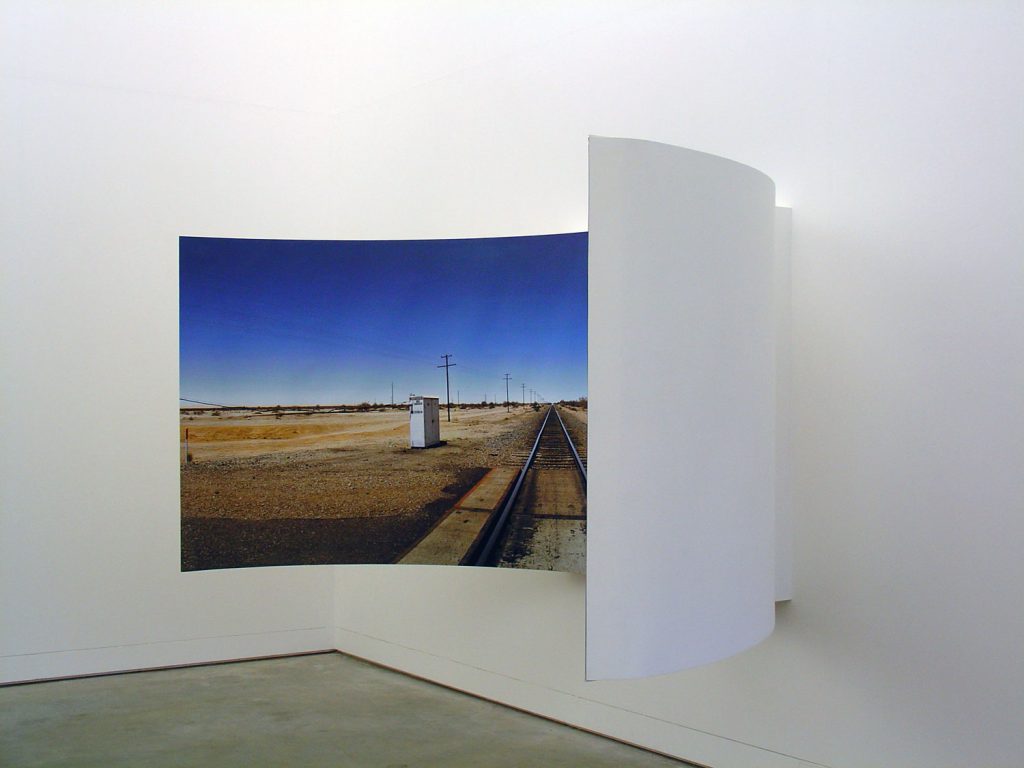
Boyd & Evans: Landmarks
Residents of Milton Keynes for almost thirty years, Fionnuala Boyd and Les Evans began working together in 1968 and have exhibited widely both nationally and internationally. Their practice incorporates traditional drawing and painting techniques, colour and black and white photography, and more recently digital imaging. Sometimes painting is dominant, sometimes photography, their subjects ranging from the personal to the epic. For the past five years they have created images broadly inspired by the abundance of natural wonders in the American landscape. For their exhibition at MK Gallery, Boyd & Evans showed new images drawn from a six week research trip in the USA, alongside a selection of earlier work. The exhibition featured examples of Boyd & Evans' 'colour in black and white process'. This process, using computer-imaging software, involves the removal of colour from all but the chosen area of focus. The reworking of the photograph intensifies the subjects' natural colour and we are prompted to experience a revival of the sensation of 'looking for the first time' at something extraordinary.
£0.00
Read more
Phil Collins: yeah…..you, baby you
UK artist Phil Collins' exhibition for Milton Keynes Gallery was his most comprehensive to date and comprised a selection of video and photographic projects and a new commission for Milton Keynes. The show included the UK première of Collins' remarkable two-screen video installation they shoot horses, 2004. For this work Collins went to Ramallah, Palestine, where he auditioned a number of young people to participate in an 8 hour 'disco-dance marathon'. The resulting film was by turns energetic, amusing, beguiling and moving. The work is about survivalism and collapse, heroism and exploitation and the cabin fever mentality generated by eight hours of repetitive action. Also shown was the world won't listen, (2005), a karaoke machine made for fans of The Smiths in Bogotá. Working with local musicians, Collins re-recorded the backing tracks of the entire album and after a city-wide campaign filmed sixty singers over three days. This exhibition was organised by Milton Keynes Gallery and subsequently toured to The National Gallery of Arts, Tirana, Albania; firstsite, Colchester; Glynn Vivian Gallery, Swansea, and Neue Kunst Halle, St.Gallen, Switzerland.
£0.00
Read more
Folk Archive: Contemporary Popular Art from the UK
Produced by Alan Kane and Jeremy Deller From our two small collections of modest objects and pictures and an ensuing conversation about the Millenium Dome's corporate representation of the UK, the question arose for us as to what might constitute present day folk art. Some seven years later, 'Folk Archive' is our response to this question and our celebration of the creative life of Britain. (Kane & Deller) Artists Alan Kane and 2004 Turner Prize winner Jeremy Deller presented a selection of works from their contemporary Folk Archive. Kane and Deller's ongoing research has explored and documented both traditional and contemporary forms of popular creativity, that brings works from one of public display to the more traditional presentation of art in a gallery. From gurning to graffiti, and tapestry to sculptures made from vegetables, Kane and Deller's project is testament to the enduring compulsion for people to find creative forms of community and individual expression. The variety of their collection was reflected in MK G's exhibition, which presented video, drawings, paintings along with objects including Snowdrop, a working, life size mechanical elephant. Energetic and engaging, this exhibition suggested how popular art has developed and questions what might constitute present day folk art.
£0.00
Read more
Daniele Puppi: Fatica n.28
Daniele Puppi is amongst the most exciting young Italian artists of his generation. Using video projection and sound, Puppi's work is a direct response to the architecture of the gallery. His work takes two forms; 'Frammenti' (fragments), photographs that evolve from the artist's engagement with a space and 'Fatiche' (efforts) which take the form of sculptural video installations. Projected large scale and with a startling intensity, Puppi's imagery often comes from the artist's own actions in the gallery; a hand – enormous in size – projected to appear slamming against the gallery wall or the artist's leg – colossal – projected as if 'ploughing' through two storeys of a building. For Puppi, the surroundings are not simply a neutral place that hosts the work of the artist, but the raw material from which the work emerges and takes form. Through the artist's distinctive treatment of his subject matter, he demonstrates that rare ability to elevate the most mundane, everyday action to the most profound.
£0.00
Read more
Kristian Ryokan
MK G presented the first solo exhibition in a UK public gallery by the British painter Kristian Ryokan. The exhibition comprised a selection of paintings intricately crafted in oil and acrylic on canvas. Ryokan plunders with an energetic enthusiasm, from the world around him using a range of everyday objects, images and signs such as monopoly boards, star wars toys, telephone cards and racing cars. Informed by the influence of Buddhist teachings, Ryokan’s paintings are often constructed with a visual play in mind. For instance a painting of a flock of pelicans in diamond formation is entitled ‘747’ (2001) and ‘Daisetz Teitaro Suzuki Zen’ (2003) depicts a D-type Jaguar seen head on. The analytical attention to detail is exquisite, the rendering of metallic and painted surfaces reveals a discerning draughtsmanship; everything is convincing until one notices the car manufacturers’ name has been replaced to simply read ‘zen’ referring to Daisetz Teitaro Suzuki the zen master. Ryokan’s subject matter often relates to a contemplation of time and escapism, activities that are removed from the day to day routine; motor racing, sailing or simply playing games. Ryokan’s work can be interpreted as looking for a balance between spirituality and materialism.
£0.00
Read more
Pae White: in no particular order
Milton Keynes Gallery presented the first solo exhibition in a British public gallery by Californian- based artist Pae White. The exhibition included new and recent work and served to introduce the varied strands of her artistic practice, that shifts effortlessly across differing genres and media, from fine art and product design to architecture and urban planning, typography and graphics. White's work is often low-tech, comprised, for instance, of repeatedly made cardboard cut-outs, delicate wire constructions, suspended mobiles or evocative ephemeral wall paintings made direct onto the building's surface. Central to her work is the playful exploration of the experience of space and light within a specific architectural setting, that results in a visually engaging experience. Of particular note are White’s papercut mobiles, such as ‘Oroscopo’, 2004. Cascading from scores of nylon threads, these brightly coloured cardboard ovoids perceptually flicker and tantalise the viewer. As ever, there is an in-built responsiveness to the conditions of the gallery space, either through the refraction of light or the passing disruption of air as a viewer walks by. A new installation, specially made for the exhibition, comprised a wall painting featuring White's characteristic 'fading' of one colour into another—at MK G turquoise into black. A selection of White's drawings, designed posters and the display of collaborative artist's books were also included in the exhibition.
£0.00
Read more
Shirana Shahbazi
This exhibition by the Iranian artist Shirana Shahbazi consisted of recent and new work including a series of tapestries, photographs and poster installation. Shahbazi uses photography to explore the classic genres of art history; portraiture, still life, landscape and history painting, both from an 'Oriental' and Western perspective. In so doing, she calls into question the exotic clichés that so often arise when engaging work from a Middle Eastern context. The exhibition featured her best known series – Goftare Nik/Good Words (2000-2001). It takes its title from the Zoroastrian maxim 'good thoughts, good words, good deeds'. This series was photographed in and around Tehran and is a compendium of social role models and social phenomena. It is a reflection on Iran, on myth-laden Persia and its portrayal and self-portrayal. Shahbazi's images exist in varying formats and media, from the small to the monumental, and her subject matter ranges from the incidental to the epic. Shahbazi's work engages traditional Iranian craft and artistic practices. This exhibition included some large format paintings made by Iranian painters employed in the advertising industry, and traditional hand woven carpets featuring exquisitely crafted images deriving from Shahbazi's original photographs. The format of Shahbazi's works reconciles the traditional with the contemporary but also questions the very cultural hierarchies on which we so often base our assumptions.
£0.00
Read more
Roger Hiorns
This was Hiorns' first solo exhibition in a UK public gallery. It comprised a selection of work from the preceding five years and provided the opportunity to see the breadth and invention of his practice. The exhibition featured a selection of Hiorns' 'crystallised' car engines. Hiorns dips the engines into a solution of copper sulphate, so that blue crystals form a baroque-like embellishment on the intricate network of pipes, wires and filters, making a stark contrast to the engines' original function as mechanical components. Also included were a series of ceramic sculptures. Hanging from the ceiling, the sculptures contained a piping system that pumped air bubbles into a solution producing columns of white foam that tentatively climbed upwards in infinite configurations until they collapsed or disintegrated. New work commissioned by Milton Keynes Gallery revealed the artist's fascination with materials and their transformation. Hiorns investigated the effects of particular substances on a group of steel sculptures. They were accompanied by 'Benign' (2005), Hiorns' film with a play written by the artist and performed by an actor as a monologue.
£0.00
Read more
Carlos Bunga
This was the first project in the UK by Portuguese artist Carlos Bunga. He was commissioned by Director Michael Stanley to make a new site-specific for Milton Keynes Gallery's Long Gallery space. Bunga builds complex structures made from corrugated cardboard held together with packing tape. The structures take over the environment they inhabit, encouraging an alternative reading of the original space. The constructions emphasise the instability of architecture. There is a possibility of growth and change; the constructions mutate, develop, extend and remain in a state of transformation.
£0.00
Read more
Phillip Allen
This was the first major solo exhibition in the UK by British artist Phillip Allen. Allen is known for his textured paintings, in which the central motif is framed at the top and bottom by multiple layers of paint that are amassed and coated over each other. Allen’s work demonstrates not only an interest in image-making, but also in the substance and nature of paint itself. The artist’s continuous practice of making numerous felt-tip sketches and drawings on A4 paper chart the inception of his abstract forms and arrangements. These drawings become the basis for his paintings where the rules of modernism are both playfully acknowledged and irreverently dismissed.
£0.00
Read more
Anja Schrey: Solo Entertainer
MK G presented the first solo exhibition in the UK by German artist Anja Schrey. The exhibition comprised new and recent works of larger-than-life size colour pencil drawings of the artist. Schrey is always the subject of the work. Taking numerous photographs to inform the choice of pose, she then works on an enlarged scale, with drawings ranging from 50cm to 4.5m across; with the resulting images dominating individual gallery walls. In the various poses she assumes, she never engages in direct eye contact with the viewer, but with an air of detachment, stares beyond the margins of the work. Schrey's influences vary; the media, the fashion industry and art history can sometimes be detected in the drawings. Occasionally the poses she adopts have been informed by performances she has made in which the audience are invited to suggest her dress, style and gesture.
